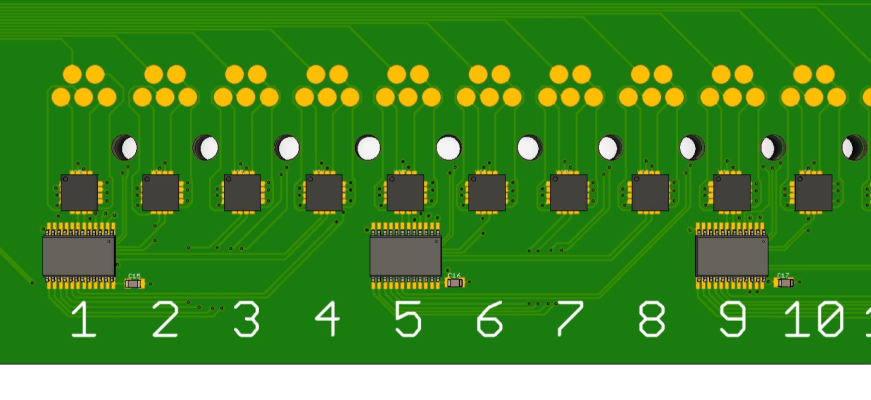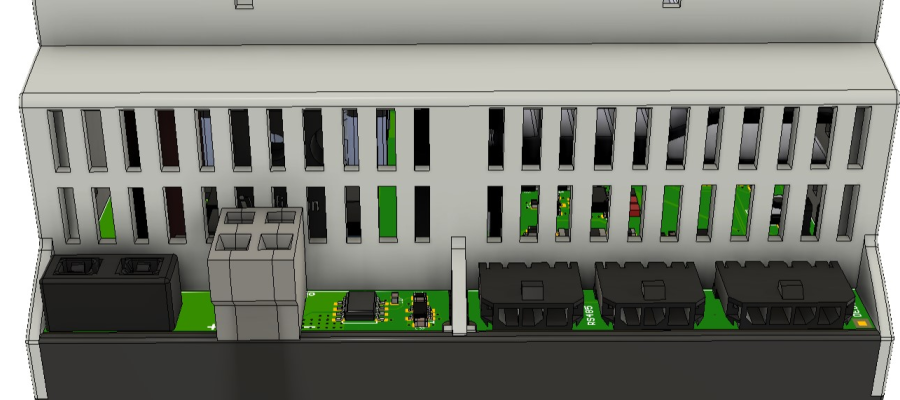
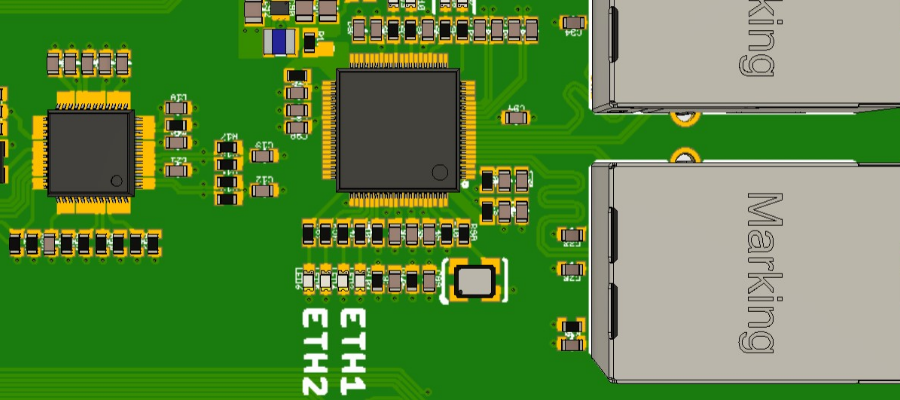
[035] ETHERNET-BASED SMART LOCKER CONTROLLER

Managing a large number of compartments with individual state detection calls for a well-thought-out I/O architecture. The core here is an ATSAMD20, which handles input multiplexing — lots of IR sensors to monitor, not much room for redundant hardware.

Each channel is watched by an infrared sensor, with state updated continuously in real time. For communication with the supervisory system, Modbus over Ethernet was the obvious pick: robust, standard, and easy to drop into any industrial infrastructure. Daisy-chained Ethernet keeps expansion simple and cuts down on cabling. A solid example of what a modular, scalable architecture actually looks like in practice.
[034] MOTORIZED POSITIONING CONTROLLER

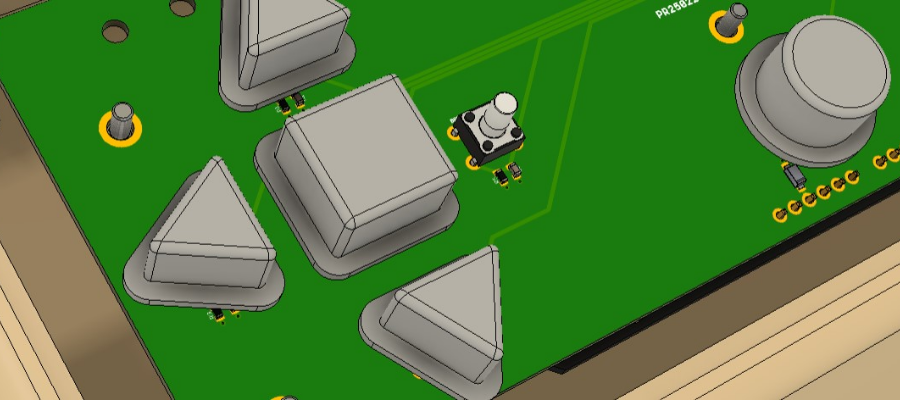
This project is built around a positioning controller with two clearly distinct operating modes.

In local mode, the operator drives the motors directly through an LCD interface that shows current position, system status, and movement state in real time. In remote mode, a UART serial link lets an external system take over and send automated positioning sequences programmatically.

The motor control logic is designed to ensure repeatable and predictable positioning. The ATmega2560 handles it all: motor control, HMI management, serial communication. Straightforward and functional — sometimes that’s exactly what a project needs to be.

[032] CABLE HARNESS TEST BENCH

Testing a cable harness by hand is tedious and error-prone. That’s what this automated bench is here to fix.

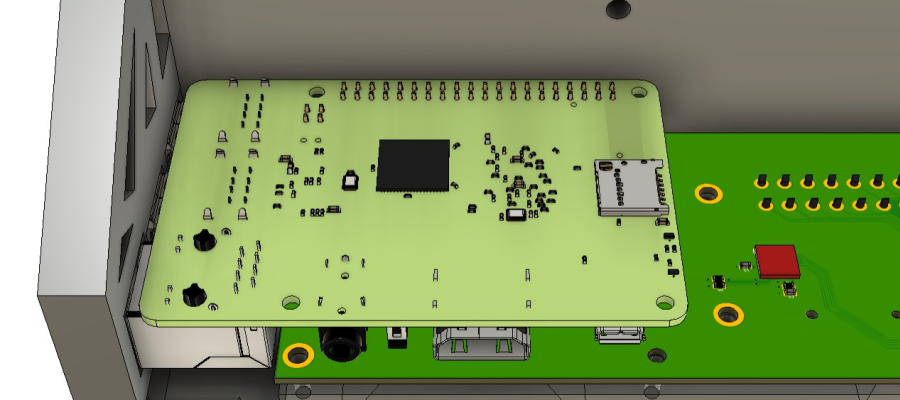
The system runs on a Raspberry Pi 4, which handles the interface and test execution. I/O expanders allow a large number of lines to be checked in parallel. The logic catches the usual wiring issues — opens, shorts, swapped or inverted lines — and updates the screen in real time as the test runs.

The interface guides the operator step by step and gives clear pass/fail results. Ergonomics were a real consideration here: the goal was a test process fast and reliable enough for an operator with no deep technical background.

[031] MULTIPLEXED RESISTIVITY MEASUREMENT SYSTEM

Measuring resistivity across multiple points without manually rewiring between each measurement — that was the goal.

Channel selection is handled through I/O expanders and multiplexing logic. Contacts are made with pogo pins: repeatable, quick to install, no soldering required. The STM32F030 sequences the measurements, does basic signal processing, and talks to the host over USB-C for both power and data.

A well-designed lab tool: compact, portable, and capable of automating a task that would otherwise be slow and prone to human error.

[030] POWER CONVERTER WITH RS485 TELEMETRY

A DC power conversion controller in the few-hundred-watt range, built around an STM32F334 — a micro that’s genuinely well-suited to power applications thanks to its high-resolution timers and ADCs.

The firmware synchronizes ADC sampling to measure bus voltage and current, applies filtering, and computes instantaneous power for regulation and monitoring. MPPT control closes the loop by adjusting the boost converter’s operating point through PWM duty cycle updates (~48 V class). Soft-start, duty limiting, and fault-triggered shutdown are all handled natively.

On the protection side, a dump load path can be activated to clamp bus overvoltage and safely absorb excess energy. Telemetry goes out over Modbus/RS485: measurements, operating state, fault codes — all exposed for supervision.