
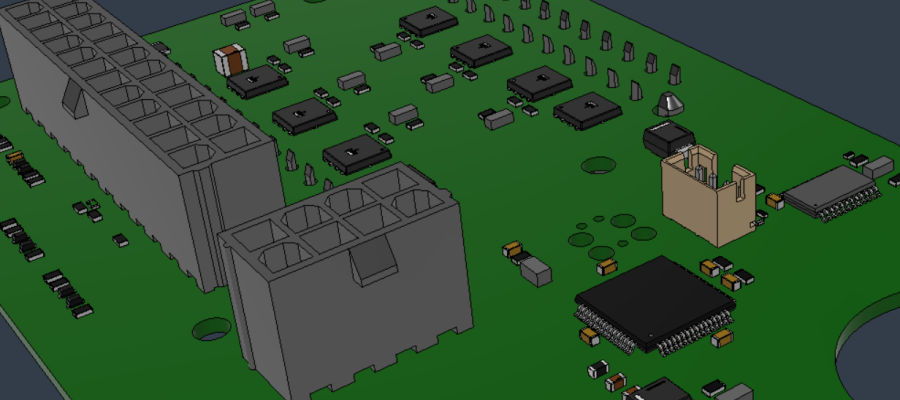
[019] MULTI-SOURCE, MULTI-VOLTAGE DC POWER DISTRIBUTION

Distributing DC power from multiple sources across multiple voltage rails at significant current levels — that goes well beyond simple routing.

Multi-source management requires OR-ing logic to prevent backfeeding and ensure clean continuity during source transitions. The PIC16F1946 supervises it all: source monitoring, fault handling, output sequencing, and status signaling.

On the PCB side, current levels pushed the design toward a reinforced stack-up with 140 µm copper. At that point, the board becomes part of the electrical design itself: track width, copper balancing, via stitching, return paths — everything matters. Power distribution stops being a background concern and becomes one of the central engineering challenges of the product.
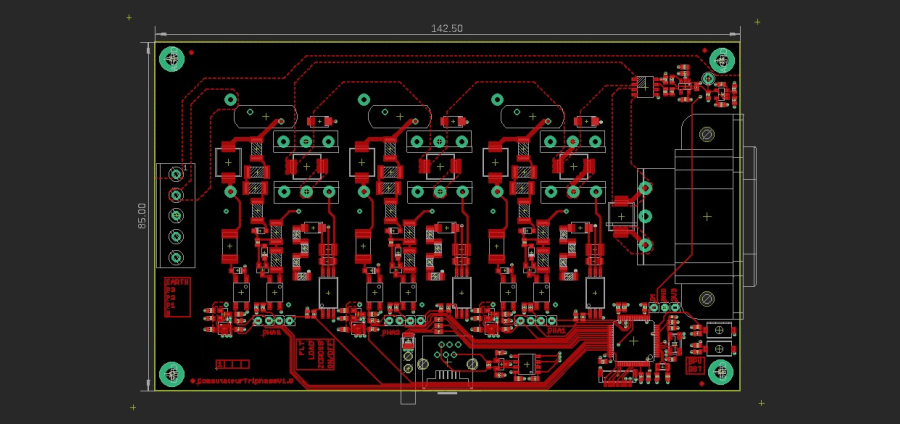
[018] AUTOMATIC MULTI-SOURCE AC TRANSFER

When the load can’t tolerate an interruption, switching between AC sources becomes a core function — not a nice-to-have.

This system monitors three-phase inputs and automatically transfers the output to a secondary source when a failure is detected on the active one. SSRs were chosen for their silent, wear-free operation and precise electronic control over the switching process.

But using SSRs on AC isn’t just swapping a relay for a semiconductor. Voltage rating, thermal dissipation, leakage current, and switching behavior under load all need to be addressed. The STM32L152RET6 handles source and load detection, determines when to switch, enforces the right transfer sequence, and prevents any unsafe overlap between sources.