
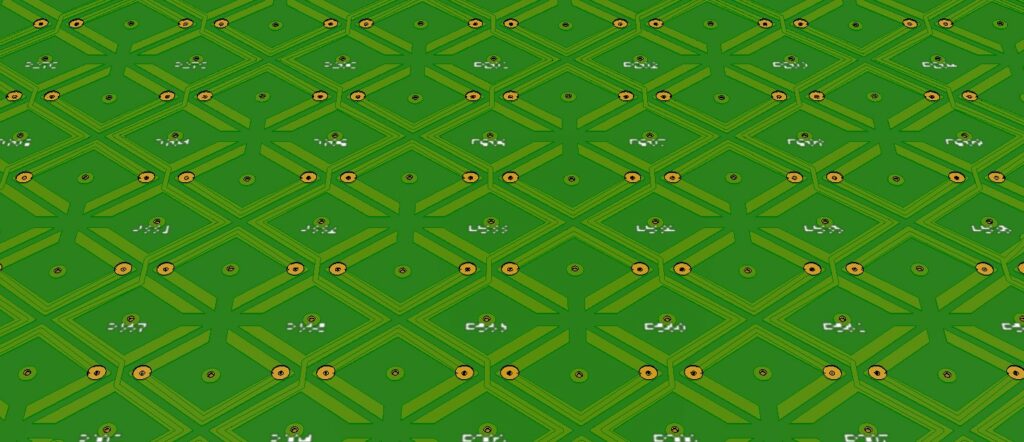
Designing a touchpad feels like a standard project — until you start pinning down the actual constraints. Here, the sensing surface was long. Very long. And the geometry ruled out any off-the-shelf electrode layout.
The chosen electrode pattern is diamond-shaped. That’s not an arbitrary call: this geometry optimizes surface coverage while minimizing dead zones between detection nodes. On a large touchpad, it makes a real difference in terms of position linearity and detection consistency across the full length.
The problem is that the physical length of the circuit exceeded what a single capacitive touch controller could handle. The solution: two IQS9150 devices cascaded together. The IQS9150 is an Azoteq controller designed for capacitive matrix management — it handles electrode excitation, capacitance measurement, and position computation internally. Chaining two of them required careful synchronization and data sharing to make both halves of the touchpad behave as a single, coherent surface.
The electrode design itself went through several iterations. Each diamond cell has to be sized for adequate sensitivity without creating parasitic coupling between adjacent electrodes. PCB routing also needs to minimize stray capacitance to the ground plane, which directly degrades measurement dynamic range.