[019] MULTI-SOURCE, MULTI-VOLTAGE DC POWER DISTRIBUTION

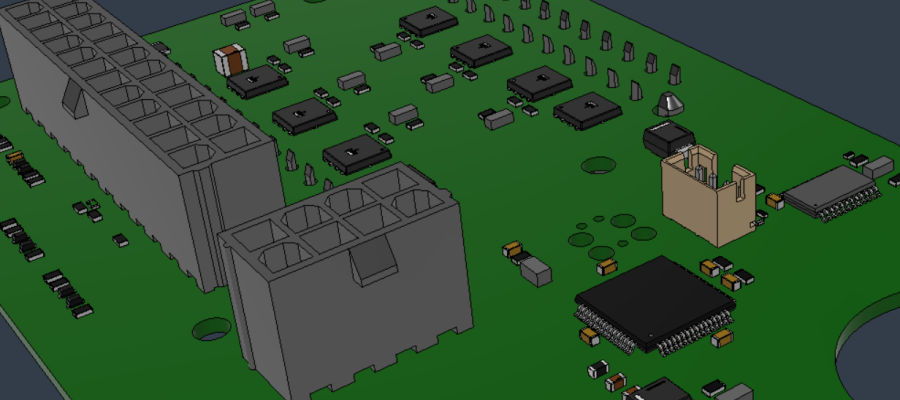
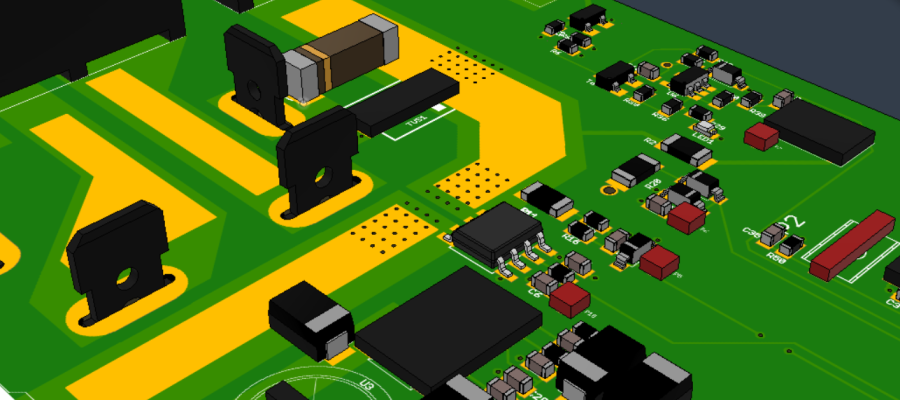
Distributing DC power from multiple sources across multiple voltage rails at significant current levels — that goes well beyond simple routing.

Multi-source management requires OR-ing logic to prevent backfeeding and ensure clean continuity during source transitions. The PIC16F1946 supervises it all: source monitoring, fault handling, output sequencing, and status signaling.

On the PCB side, current levels pushed the design toward a reinforced stack-up with 140 µm copper. At that point, the board becomes part of the electrical design itself: track width, copper balancing, via stitching, return paths — everything matters. Power distribution stops being a background concern and becomes one of the central engineering challenges of the product.
[018] AUTOMATIC MULTI-SOURCE AC TRANSFER

When the load can’t tolerate an interruption, switching between AC sources becomes a core function — not a nice-to-have.

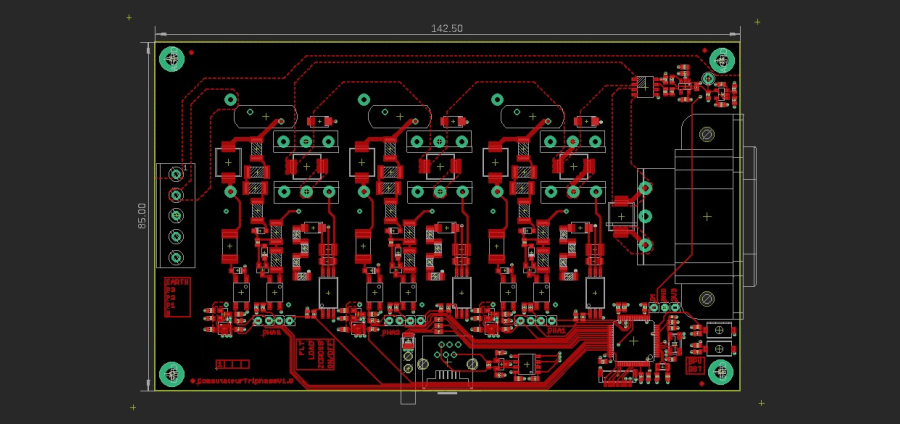
This system monitors three-phase inputs and automatically transfers the output to a secondary source when a failure is detected on the active one. SSRs were chosen for their silent, wear-free operation and precise electronic control over the switching process.

But using SSRs on AC isn’t just swapping a relay for a semiconductor. Voltage rating, thermal dissipation, leakage current, and switching behavior under load all need to be addressed. The STM32L152RET6 handles source and load detection, determines when to switch, enforces the right transfer sequence, and prevents any unsafe overlap between sources.

[017] MICROTURBINE LOAD REGULATOR

A microturbine doesn’t stop generating because the network doesn’t need its power anymore. You need somewhere to send the excess energy — that’s the job of the dump load regulator.

This buck-based regulator at 12 V / 300 W actively manages energy transfer into the dump load rather than relying on simple passive dissipation. At 300 W, component selection, copper sizing, switching behavior, and thermal paths are all serious topics that need real attention.

The STM32L152RET6 handles regulation logic, measurements, and system supervision. Modbus/RS485 telemetry exposes operating values and status for integration into a wider supervision system. A project where power electronics and embedded control genuinely have to work as one.

[016] PORTABLE NAVIGATION DEVICE

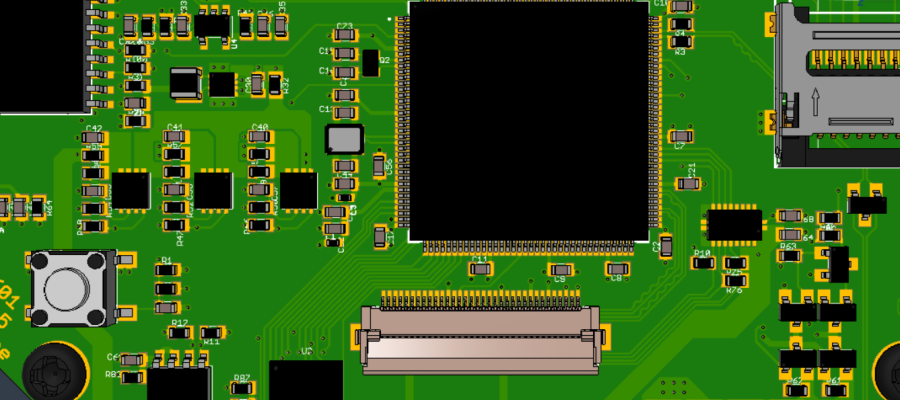
GPS + accelerometer + magnetometer + gyroscope + OLED display, all in a portable enclosure. The idea: a device that knows where it is and can tell you which direction to go.

The STM32L4R9ZIT6 sits at the center, combining multi-sensor acquisition, positioning algorithms, and display control. GPS gives the global position; inertial and magnetic sensors provide orientation in space. The real challenge is in the data fusion layer: filtering raw measurements, compensating for drift, extracting a reliable heading.

The OLED display translates all of that into an interface you can actually use in the field. A nice example of how sensor fusion can be turned into a practical navigation tool that fits in your pocket.

[015] RACK-MOUNT AC POWER DISTRIBUTION UNIT

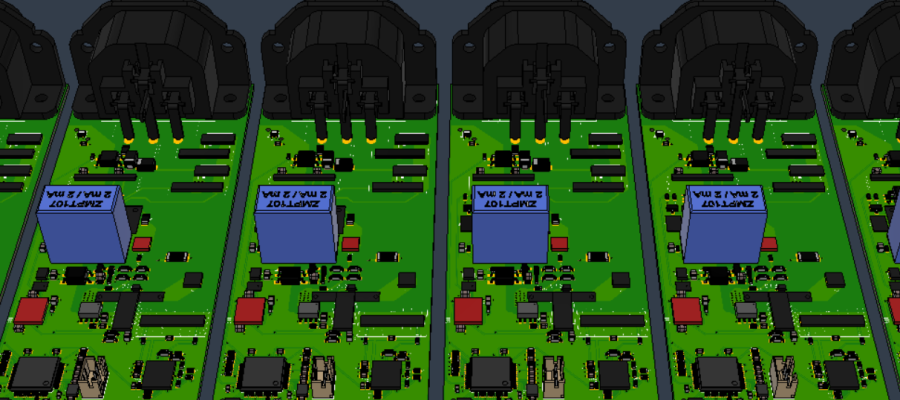
A 1U 26-inch rack-mount AC power distribution unit with SSR-based switching, Ethernet telemetry, and a MIB-based protocol. The STM32H563VGT6 manages switching control, telemetry handling, and overall system supervision.

The 1U rack format imposes hard mechanical constraints right from the start: PCB layout, connector placement, thermal management, component height — everything has to fit within the envelope before anything else gets decided.

SSRs bring silent, wear-free switching. Ethernet connectivity turns the PDU into a networked device: channel status, remote supervision, integration into centralized control systems. Not just a fancy power strip — a connected power control platform built for structured professional deployment.